

Dec
TIN TỨC
Comparison of Umbilical Cord Blood Stem Cells and Baby tooth pulp: Similarities and Differences!
Umbilical cord blood stem cells and dental pulp stem cells both offer promising potential in disease treatment, each with its own strengths. While umbilical cord blood stem cells are particularly effective at producing blood cell lineages, dental pulp stem cells excel in rapid proliferation and anti-aging capabilities, making them well-suited for neurological therapies and connective tissue regeneration.
Baby tooth pulp and Umbilical Cord Stem Cells: Similarities
Flow cytometry analysis shows that both types of MSCs do not express hematopoietic or endothelial-specific antigens (CD14, CD34, CD45) at rates above 5%, regardless of early or late stages. In contrast, they exhibit high expression (over 95%) of typical mesenchymal markers such as CD29, CD44, and CD90. After 10 days of culture, both cell types maintain their viability and stem cell surface characteristics [3]. Numerous studies have demonstrated that MSCs have therapeutic potential for a variety of conditions, including neurodegenerative diseases, rheumatoid arthritis, limb ischemia, and diabetes [4,5,6,7].
Previous research has indicated that mesenchymal stem cells (MSCs) are an attractive source for tissue engineering and regenerative medicine due to their self-renewal ability and multipotent differentiation potential [1]. Although bone marrow and adipose tissue are the primary sources for scientific research and clinical therapies, they have certain limitations, including relatively low proliferation and differentiation capacity and the need for invasive collection procedures, which restrict their broader application [2,3].
Therefore, mesenchymal stem cell (MSC) sources require further research and development to overcome these limitations. Recently, MSCs from umbilical cord (UC) stem cells and dental pulp (DP) stem cells have gained significant attention due to their convenient collection procedures, excellent proliferation and differentiation capabilities, low susceptibility to bacterial and viral contamination, and minimal ethical concerns in medical practice.
Baby tooth pulp vs. Umbilical Cord Stem Cells: Differences!
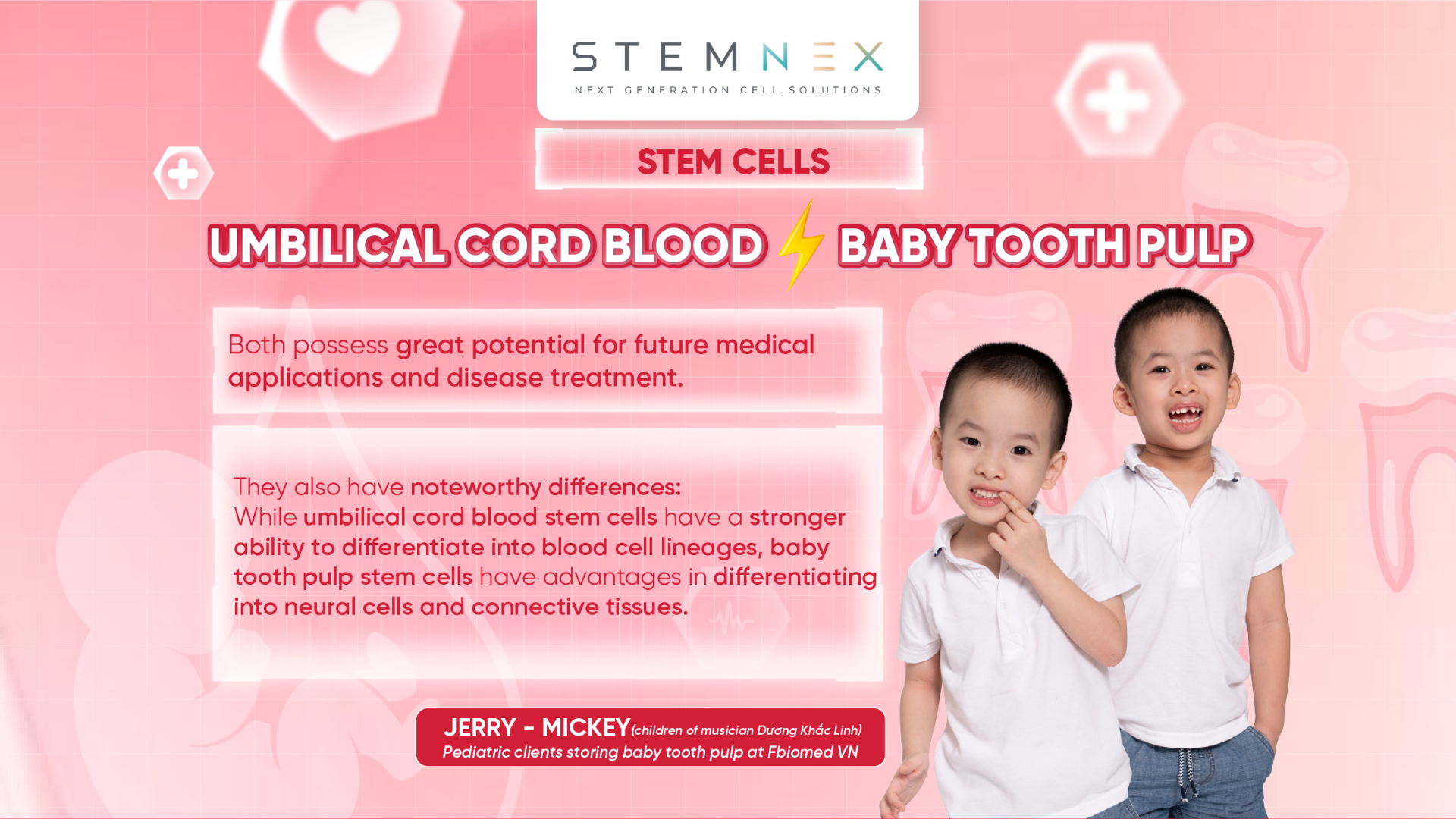
Proliferation Capacity of Mesenchymal Stem Cells (MSCs) from Umbilical Cord and Baby tooth pulp
Experiment 1:
The high survival capacity of the cells was demonstrated using Alamar Blue staining and metabolic indicators such as glucose consumption and lactate production. Evaluations showed that the proliferation of both MSC sources follows three phases:
Initial phase (first 2 days): slow cell growth
Rapid growth phase: lasting 4–5 days
Stable growth phase: by days 6–7, cells reach a stable proliferation rate
*Notably, umbilical cord MSCs (UC-MSCs) began proliferating faster than dental pulp MSCs (DP-MSCs) from the second day, indicating that UC-MSCs require less time to reach the desired cell quantity.
After 10 culture passages, both MSC types showed similar results in terms of cell count, viability, and metabolic indicators, demonstrating that they maintain high proliferation rates across different stages.
Experiment 2:
In 2016, Ren and colleagues compared the biological characteristics of mesenchymal stem cells (MSCs) derived from umbilical cord (UC) and dental pulp (DP) [3]. Part of this phenomenon can be explained by the shift from glycolysis to oxidative phosphorylation. Although mitochondrial glucose oxidation generates more energy (36 ATP per glucose molecule) compared to glycolysis (2 ATP per glucose), it also produces reactive oxygen species (ROS), causing oxidative stress, cellular aging, and apoptosis [10]. Therefore, like tumors and malignant cells, MSCs often rely on glycolysis for ATP production even in the presence of oxygen, a phenomenon known as the Warburg effect [11].
The results showed that umbilical cord MSCs (UC-MSCs) have superior proliferative capacity compared to dental pulp MSCs (DP-MSCs). Additionally, UC-MSCs produce higher levels of lactate than DP-MSCs. When cultured on plates, UC-MSCs exhibited a polygonal shape with distinct cytoplasmic granules, whereas DP-MSCs maintained a fibroblast-like morphology more effectively. This suggests that DP-MSCs may better preserve stem cell morphology after transplantation.
Differentiation of Baby tooth pulp and Umbilical Cord Stem Cells
Regarding the differentiation potential of the two cell types, a study cultured MSCs from both sources in osteogenic and adipogenic induction media. Osteogenesis was determined by calcium deposition, while adipogenesis was identified by lipid droplet formation. The results showed successful differentiation into both osteoblasts and adipocytes.
Semi-quantitative analysis demonstrated that while both DP-MSCs and UC-MSCs have adipogenic potential, DP-MSCs exhibited significantly better osteogenic differentiation than UC-MSCs, even at later stages [3].
Senescence of Baby tooth pulp and Umbilical Cord Stem Cells
To evaluate whether senescence occurs similarly in MSCs derived from umbilical cord (UC-MSCs) and dental pulp (DP-MSCs), β-galactosidase staining was used. The results showed that DP-MSCs aged significantly slower than UC-MSCs at passages 2 and 10, although no significant difference was observed at passage 6.
Additionally, flow cytometry analysis indicated that apoptosis rates were low in both cell types, with DP-MSCs showing approximately 10 times lower apoptosis than UC-MSCs. No significant differences in apoptosis were observed at passage 10. This suggests that DP-MSCs have better resistance to programmed cell death, followed by UC-MSCs.
Human mesenchymal stem cells derived from umbilical cord and dental pulp possess self-renewal capacity and multipotency. Compared to UC-MSCs, DP-MSCs may offer advantages in bone injury treatment due to higher osteogenic differentiation and lower apoptosis, moderate senescence, and balanced proliferation. However, further comparative studies are necessary to evaluate their potential in neural, cardiac, hepatic, pancreatic, and other lineages, as well as their therapeutic efficacy in vivo.
Conclusion
Both umbilical cord blood stem cells and dental pulp stem cells hold tremendous potential for future disease therapies. Both types are capable of regeneration and differentiation into multiple cell lineages, offering opportunities in the treatment of hematological, neurological, cardiovascular, and other regenerative medicine applications.
However, storing umbilical cord blood stem cells is considered a “golden opportunity”, as the quantity of stem cells collected from the cord is usually greater than that from dental pulp, enhancing their applicability and therapeutic efficacy. Notably, while umbilical cord stem cells excel at differentiation into blood cell lineages, dental pulp stem cells have advantages in differentiating into neural and connective tissue lineages.
Storing Baby‑Tooth Dental Pulp Stem Cells at STEMNEX ASIA
StemNex Asia operates in the field of collection, preservation, storage, and transportation of dental pulp stem cell samples using technology transferred from Germany (Thermo Fisher). StemNex Asia provides personalized medical solutions, increasing the chances of long-term health by leveraging the “health gift” from your child’s own dental pulp a once-in-a-lifetime opportunity to build a health shield for the entire family.
Triple compensation in case of sample damage
Cost reservation policy until successful sample collection
Support for international shipping procedures, ensuring customs clearance and storage quality according to ISO 9001:2018 and Cleanroom Class 10,000 standards
Collaboration with foreign organizations and individuals for tissue exchange for diagnosis, treatment, training, and research purposes


